
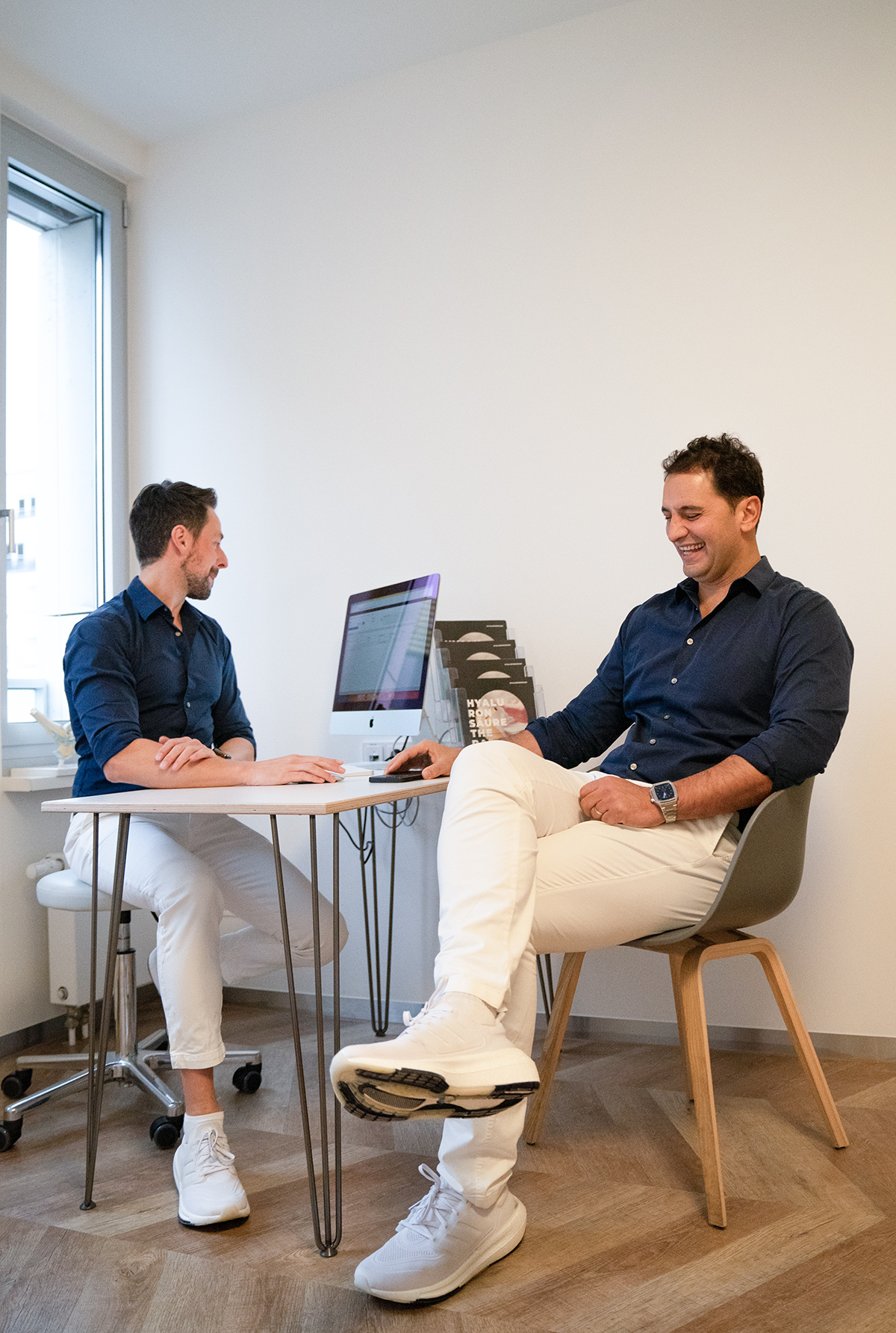
We treat the entire spectrum of orthopedic conditions based on decades of experience and contemporary, guideline-based therapeutic approaches. First and foremost, we are doctors who make use of all possibilities so that surgical treatment is only considered as the last possible option. We have a wide range of options at our disposal that support traditional methods such as physiotherapy and pain medication.
If a conservative approach is not sufficient, we can help with outpatient surgery at Outpatient Surgery Center Berlin sowie stationären OPs im St. Gertrauden Hospital behilflich sein.
No clear diagnosis can be made without diagnostics and no appropriate treatment can be given without a diagnosis.It is the first step and essential before any therapy. Particularly with regard to prevention, we take deep stability and deep mobility into account during diagnostics, as well as recognizing possible incorrect postures that could lead to injuries or illnesses in the future.
With the help of magnetic resonance imaging (MRI) as an examination method, many cross-sectional images of the body can be made, especially of the soft tissue of the body, such as the spinal cord, ligaments (joints) or internal organs.
MRI for private patients & self-payers: Diagnose Centrum Berlin am Emser Platz 1(for patients with statutory health insurance: by appointment in the sports medicine network)
The radiological examination of the musculoskeletal system is an imaging procedure that shows bones, joints, ligaments and muscles. This allows us to localize injuries and assess their severity.
High-resolution ultrasound helps to differentiate between serious injury/rupture, hardening, strain or tear, including in the shoulder (calcifications, bursitis, etc.), elbow (tennis or golfer’s elbow), foot (ligaments & Achilles tendon), knee (kneecap, tendons, cysts) and muscles (strain, hardening, tear).
The low-dose X‑ray examination measures the density of the bone, i.e. the mineral content. It provides information on the personal risk of osteoporosis and is only useful from a medical point of view if there are concrete indications that (pronounced) bone loss is already present.This is how the onset of osteoporosis can be determined.
Bone densitometry & 4D measurement at Ku’damm: Shiva Medicare: Shiva Medicare
We have a wide range of therapy options at our disposal. Depending on the clinical picture, we decide on the form of therapy that supports your regeneration process in the best possible and, above all, sustainable way.
In the musculoskeletal system, it is primarily the joints, tendons, ligaments and muscles that can show various changes.
In the case of acute injuries or damage caused by chronic mechanical overload, the body activates a variety of regenerative mechanisms to heal the tissue. This can lead to disorders, particularly in the case of prolonged courses. Platelet-rich plasma (PRP), also known as autologous blood therapy, is obtained from a blood sample that is centrifuged to produce a concentration of platelets. The activation of these platelets induces a large number of proteins such as growth factors and anti-inflammatory agents. These have a strongly positive effect on regeneration and the healing process. The anabolic, i.e. anabolic effect, leads to a significant acceleration of holistic therapy (physiotherapy, relief) in the short and medium term and provides directional support.
The increasing experience with this technique over the last 15 years shows the resounding success of working with the body’s own defenses.
Areas of application
Osteoarthritis of the large joints (hip, knee, ankle, shoulder, elbow)
Tendon attachment inflammation (e.g. trochanteric bursitis, GTPS, partial Achilles tendon tears)
Tennis and golfer’s elbow, heel pain/plantar tendon fasciitis)
Tendon damage (e.g. patellar tendonitis/jumper’s knee)
Muscle Injuries
What is joint wear and tear?
Inflammation and degenerative changes in joints, such as cartilage diseases and osteoarthritis, and/or in tendons (tendinosis) can lead to severe restrictions in quality of life due to pain and deterioration in mobility. The reduction in activity can also lead to secondary problems (e.g. weight gain, increase in blood pressure, social withdrawal, etc.).
Treatment helps to stabilize the quality of life and slow down the aging process. Prevention is the key word in orthopedics. It is therefore important to prevent and counteract further deterioration at an early stage. In combination with physiotherapy and optional initial drug treatment, there is a significant improvement in symptoms if the indications are correct.
What is hyaluronic acid?
Hyaluronic acid is a protein that occurs naturally in the body in various tissues, including cartilage. Injections of hyaluronic acid are an established treatment option for cartilage diseases and incipient osteoarthritis. This can improve the function of the joint and significantly reduce pain. This reduces the need for painkillers and improves quality of life. Furthermore, the treatment delays the further progression of degeneration, among other things by stimulating the body’s own hyaluronic acid production. Hyaluronic acid can also be used successfully on tendons and ligaments.
„Injections of hyaluronic acid are an established treatment option for cartilage diseases and incipient osteoarthritis.“
Shockwave therapy originally comes from renal medicine, where patients with inoperable kidney stones were successfully treated.
As these consist of calcium, orthopedic surgeons have adopted this technique for the treatment of calcified shoulders. This showed that inflammatory conditions and irritations could also be treated successfully. The therapy could also be used for other conditions such as tennis elbow, bursitis and other musculoskeletal disorders.
Extracorporeal shockwave therapy (ESWT) works with high-energy, audible sound waves that are sent over the surface of the body into the depths and thus to the desired target structure. This increases blood flow to the tissue and releases growth factors via a process called mechanotransduction. Both contribute to the activation of the body’s self-healing powers and thus to faster regeneration. This technique has become established in sport for a variety of overuse-related complaints, chronic pain or degenerative diseases.
Areas of application
Shoulder pain, e.g. calcified shoulder
Tennis elbow, golfer’s elbow
Patella tip syndrome (jumper’s knee)
Shin splints
Achilles tendon pain (Achillodynia)
Heel spur (plantar tendon fasciitis)
Muscle tension (trigger point treatment), muscle injuries
IT band syndrome (runner’s knee)
Bursitis (inflammation of the bursa)
Injection therapy with herbal & mineral complex preparations
For inflammatory and degenerative diseases of the musculoskeletal system such as bruises, sprains, dislocations, tendonitis and bursitis or osteoarthritis of the joints, we offer injections with herbal and mineral complex preparations. According to current knowledge, the herbal and mineral components probably restore the balance of the „inflammatory system” on an epigenetic level. They have a decongestant, pain-relieving and anti-inflammatory effect.
Cortisone and other classic anti-inflammatory agents can effectively interrupt inflammatory chains in certain areas, but they also hinder the healing effect of the inflammatory process. We therefore try to avoid cortisone injections whenever possible.
Infiltration Therapy
During an infiltration, a medication is administered to the body via a syringe.
The needle gets under the skin, into a joint, into a muscle or into the spinal canal. This allows the medication to act directly on the area causing the pain. The injection usually contains a local anesthetic, hyaluronic acid, PRP or Traumeel. Of course, we tailor the appropriate therapy to the diagnosis.
Areas of application
Nerve root irritation
Inflammations
Tensions
Chronic pain
Acute injuries
Infusion Therapy
We have a wide range of therapy options at our disposal. Depending on the clinical picture, we decide on the form of therapy that supports your regeneration process in the best possible and, above all, sustainable way.
A balanced diet rich in protein and vitamins plays a key role for our body.
A balanced diet rich in protein and vitamins plays a key role for our body. However, deficiencies usually play a major role in susceptibility to injury, the development of illness and lower energy levels in everyday life. To eliminate these limiting factors, infusion therapy is an optimal treatment tailored to you. Whether it is used for regeneration after intensive sporting activities or to stabilize the body’s own defences, infusion therapy primarily provides balance. The infusions contain fluids, amino acids, vitamins, electrolytes and antioxidants. The direct supply via the blood is particularly suitable for people with a sensitive stomach. Compared to food supplements, which are absorbed via the digestive tract, infusions have a 100% absorption rate and reach the target site directly to unfold their effect immediately. This means that the fluid balance and vitamin and micronutrient requirements can be quickly balanced.
Areas of application
After intensive sporting activity (e.g. marathon)
Muscle atrophy (sarcopenia)
Recurrent muscle injuries
Osteoarthritis
Chronic fatigue
Osteoporosis
Chronic inflammation and pain
Wound healing
Vitamin and electrolyte deficiency
Deficiency of vital substances (micro- and macronutrients)
The term kinesio tape is short for „kinesiological tape”.
Seine Anwendung, das Tapen, geht auf Kenzo Kase zurück, einen japanischen Chiropraktiker, der Anfang der 70er Jahre mit dehnbaren Verbandsmaterialien schmerzende Gelenke und Muskeln behandelte. Über die Dekompression an der Haut und der damit zusammenhängenden Verschiebung der unterschiedlichen Gewebeschichten kommt es zu einer Verbesserung der Durchblutung sowie Entlastung der betroffenen Muskelregionen. Vor allem die Spannungsänderung der Muskulatur, die Schmerzreduktion durch den neuro-sensorischen Input sowie Verbesserung des Lymphabflusses können durch die Anlage erreicht werden. Durch die korrekte Anlage können auch Schmerzmanagement und abschwellende Maßnahmen nach Unfällen (Sprung- oder Kniegelenksverdrehungen, akute Schwellungen) durch Stabilität erreicht werden. Durch das myofasziale Release erfolgt eine Entlastung der Beschwerden, ohne das betroffene Gelenk vollständig immobilisieren zu müssen.
Areas of application
Muscle injuries (pain, strains, overuse, fibre tears)
Joint injuries (pain, overloading, inflammation, swelling, instability)
Ligament injuries (pain, overloading, inflammation, torn ligaments)
Water retention (oedema)
Originating from Traditional Chinese Medicine (TCM), this highly efficient treatment concept with few side effects has long since established itself in the Western world.
Acupuncture is based on the Yin & Yang doctrine, includes the five elements and the doctrine of meridians (energy channels). The starting point is Qi, a life energy that flows through everything. If blockages, injuries or chronic complaints occur, the Qi is blocked and the energy flow is interrupted. The aim of the needles is to rebalance the blocked energy and stimulate self-healing.
The approximately 400 acupuncture points are located on the meridians, with each point being assigned to an organ or organ circuit with a corresponding healing effect. By placing the needles on the acupuncture point according to the symptoms, stimulation takes place, which then triggers a reaction in the nervous system that has a reflex effect on the targeted organ, organ circuit and tissue.
The insertion may be painful for a brief moment, which indicates that the right point has been found. The needles then remain in the skin for approx. 20–30 minutes and are removed afterwards. For a lasting effect, especially if your symptoms are chronic, the treatment should be carried out regularly.
Acupuncture promotes the regeneration of your tissue and also has a very relaxing and soothing effect. Patients are often surprised by how quickly it works. That’s why we offer acupuncture in our practice as an alternative healing method to conventional medicine as part of our range of therapies.
Another therapy option for regeneration is dry needling — intramuscular stimulation (IMS) of trigger points.
Myofascial trigger points are one of the most common causes of chronic pain in the musculoskeletal system. Dry needling can be used to treat myofascial trigger points and fascia. The sterile needles are inserted into the relevant areas to release tense muscles and fascia.
In detail: The insertion into the trigger point triggers a local twitching of the hard tension cord (tense muscle fibre bundle). The twitching as a reaction to the puncture stimulates the oxygen supply to the tissue, improves blood circulation, loosens the adhesions of the fascia structures and reduces inflammation of the respective trigger points. The aim is to restore normal blood circulation in the trigger points so that the pain disappears. Many patients describe and experience the moment of the puncture, the „twitching reaction” as a pleasant „feel-good pain” and as relieving.
We use dry needling successfully as a pain therapy in our practice. You can find out more about this in consultation hours, in direct dialogue with the doctors.
Cryotherapy is a medical treatment with cold, neuroreflective cold therapy, in which the CO2 laser-controlled CRYOLIGHT® is used.
It is used for acute pain, injuries and swelling. The primary aim is to eliminate pain. By cooling the tissue to approx. 4–0° degrees, the pain receptors and nerve fibres are virtually blocked. This can quickly reduce the pain, which lasts for up to 3 hours. An anti-inflammatory effect can also be achieved.
In the case of injuries that swell due to the tissue hormones histamine, serotonin and prostaglandins cause swelling, overheating and pain, the inflammatory mediators can no longer be sufficiently removed. Cold therapy restores the partial permeability of the vascular membrane so that inflammatory mediators and the intercellular fluid can be removed via the vessels again. In addition, the slow, circular movements on the skin stimulate the lymphatic vessels for up to 30 minutes after the treatment, which allows the treated area to decongest.
Areas of application
Acute injuries / swelling in (competitive) sport
Inflammation after trauma
Haematomas
Injections for pain relief
Tendonitis or bursitis, calcifications
Chronic joint inflammation such as rheumatism, osteoarthritis or gout
If a conservative approach is not sufficient, we can help with outpatient surgery at Outpatient Surgery Center Berlin sowie stationären OPs im St. Gertrauden Hospital behilflich sein.
Arthroscopy is a joint-preserving procedure.
The arthroscope, usually consisting of an optical system of rod lenses, a light source and an irrigation and suction device, is inserted into the joint space through two small incisions in the skin. This allows the affected joint, which is displayed directly on the monitor, to be examined and, if necessary, treated immediately. Arthroscopy is part of minimally invasive surgery, which tends to cover minor injuries.
If a joint can no longer fulfill its function or is restricted in its movement, an endoprosthesis, an artificial joint, is inserted. This serves as a joint replacement and should remain in the body for as long as possible.
8–12 / 14–17 Uhr
8–13 Uhr
8–9 / 14–15 Uhr
8 – 9 am
Die Akutsprechstunde findet ab dem 01.10.2026 wieder statt.
Aufgrund eines kurzfristigen Personalengpasses muss unsere Akutsprechstunde leider bis einschließlich 30. September ausfallen. Ab Oktober sind wir wieder wie gewohnt für Sie da. Vielen Dank für Ihr Verständnis!
| WED | 1–3 pm |
|---|---|
|
FRI |
1–3 pm |
|
SAT |
9–11 Uhr |
 EN
EN  DE
DE